Want to learn how to tie an ascot? Here’s everything you need to know.
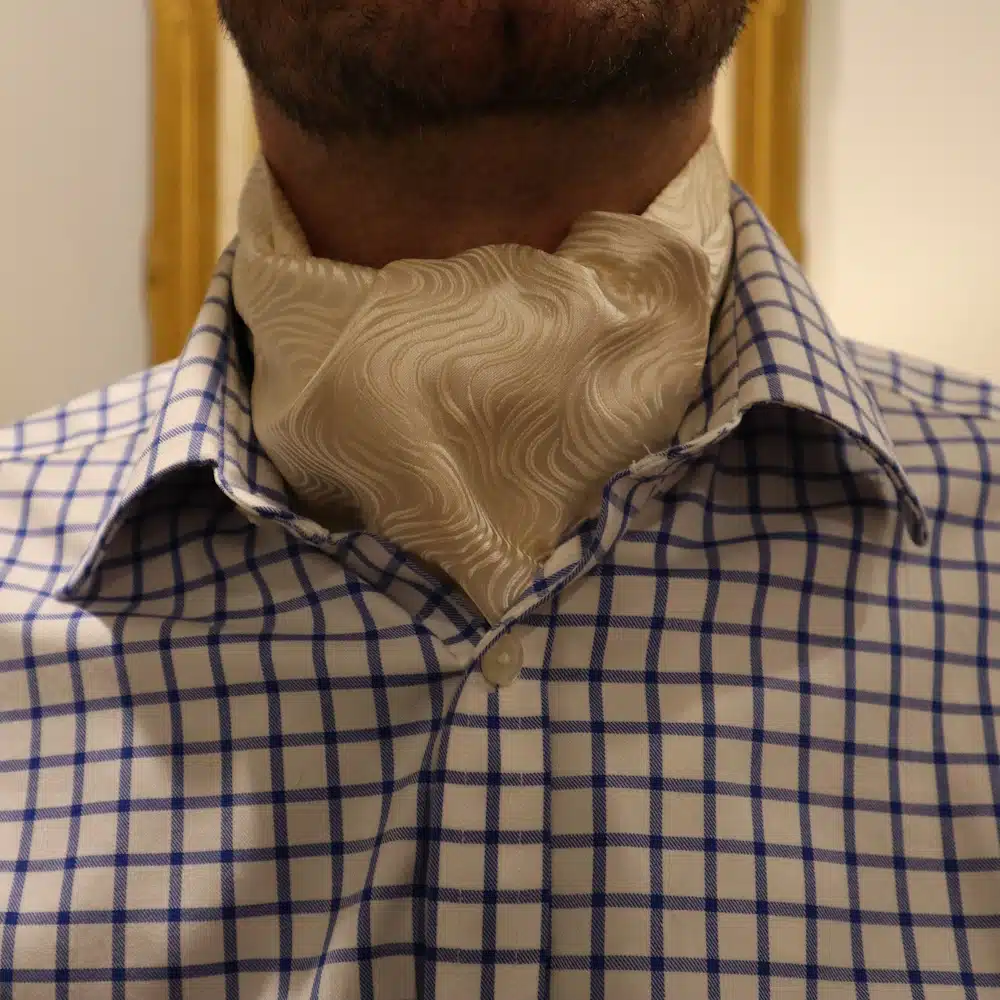
An ascot is more than just a racecourse in England. It’s a piece of neckwear that predates the modern necktie; arguably, the latter is derived from the former. So, like the racecourse, ascots (as in the neck accessory) are truly historical.
What they aren’t, however, is history. An ascot certainly isn’t everyday wear, but it’s still relevant today. People often wear ascots at formal day events like weddings and, of course, upscale horse races.
While ascots certainly aren’t for everyone, knowing how to tie an ascot might be a helpful thing to have in your back pocket.
Before we get to that, though let’s get more specific about what an ascot is exactly.
What Is an Ascot Tie?
An ascot tie is a piece of neckwear that consists of a band that wraps around the back of your neck and two wide wings at each end, meant to be tied at the front of your neck. It’s usually made of silk and is traditionally worn as a casual counterpart to regular ties for formal daytime dress codes.
It evolved from a thicker, heavily starched piece of linen worn in the early 1800s. This accessory was tied in a far more elaborate way.
By the late 1800s, men started to wear this item more loosely, especially during the day, eventually this accessory morphed into the ascot we know today.
The modern necktie, as we know it, was the next evolution which happened in the 1920s.
Cravat vs Ascot
Whether or not you say “cravat” or “ascot” is based mostly on your language or dialect.
In North America, an ascot is simply a type of cravat, which is any decorative piece of cloth tied around the neck. So, while a small silk scarf tied around your neck and tucked into your shirt is often what people think of when they think of a cravat, an ascot is technically a cravat, too.
I liken this to the terms “automatic” and “mechanical” in the watch world. Though an automatic is a type of mechanical, the phrase “mechanical” is often reserved for non-automatic mechanicals to differentiate them from automatics.
Though an ascot is a cravat, the latter phrase is often reserved for any non-ascot neckerchief. Relatedly, this means that regular neckties and bowties are also technically cravats.
But again, most would simply refer to them as what they are specifically. I rarely hear people call a bowtie a cravat.
In England, though, what North Americans call an ascot is what they call a day cravat.
Meanwhile, their dress cravat has the same design as a day cravat but is made of thicker, woven silk. It’s a bit more like a thick, modern necktie. It’s also usually black or gray, compared to day cravats, which can be colorful or patterned.
Tying an Ascot: Step by Step
Here are two ways to do it:
The Traditional Ascot Tie
Place the neckband around the back of your neck. When the wings hang over your chest, just make sure that one side hangs longer than the other. Around three to five inches is perfect.
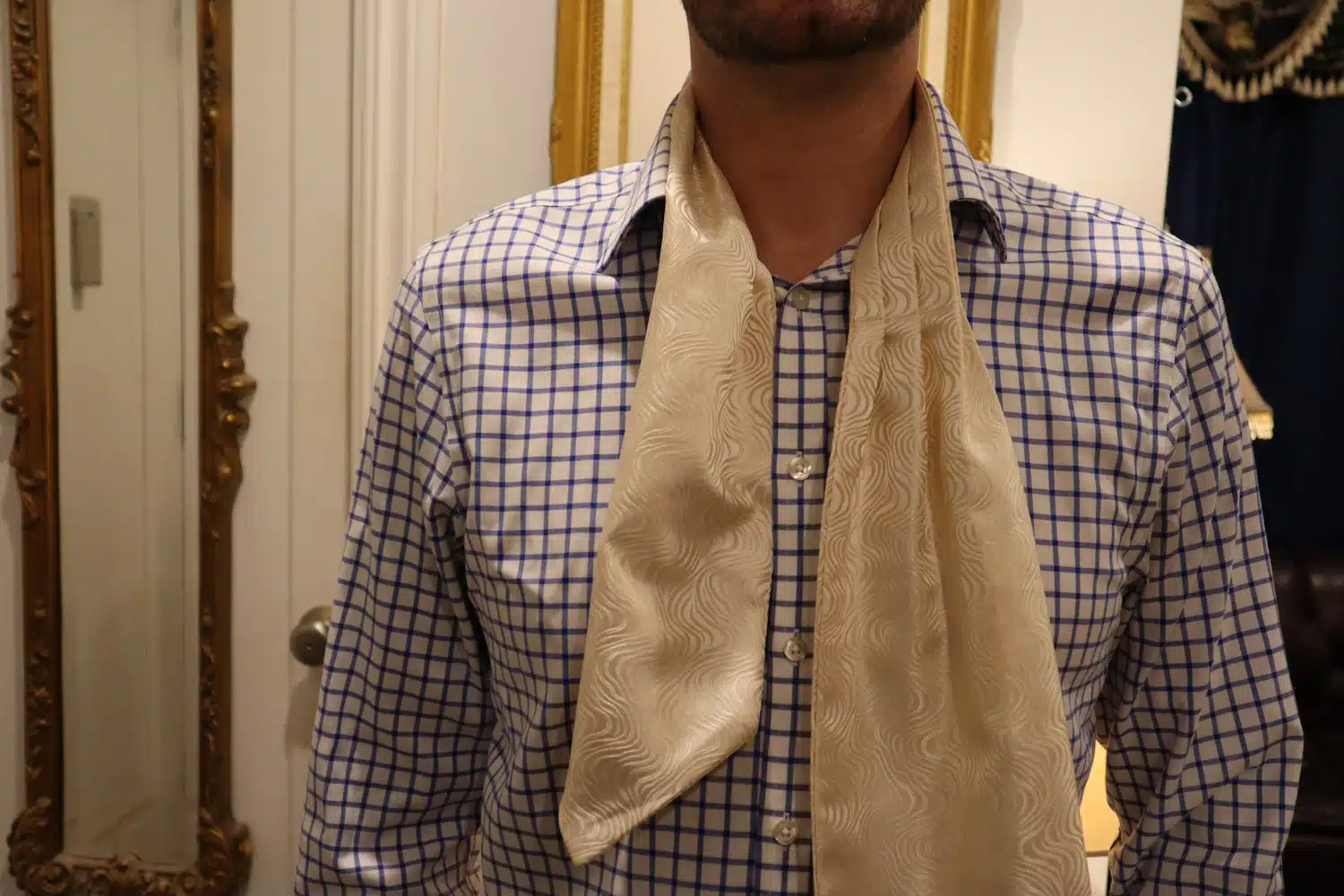
Place the longer end over the shorter one, keeping the crossed pieces close to your neck.
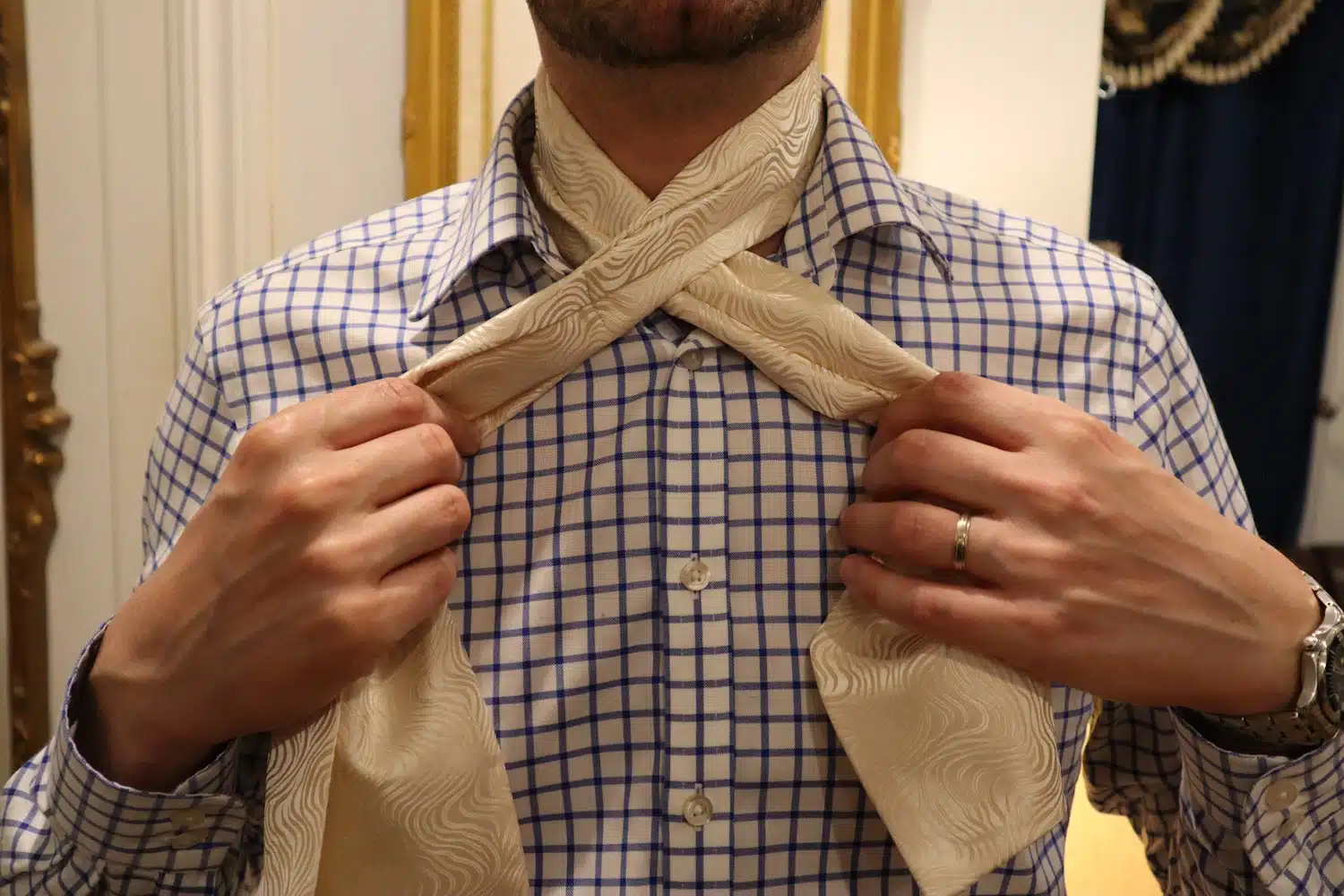
Steps three and four are best done in one swoop, but I’m separating them into two steps for clarity! You’re going to wrap the longer end around the shorter end. So, bring that longer end over the shorter end, then underneath it, then back over.
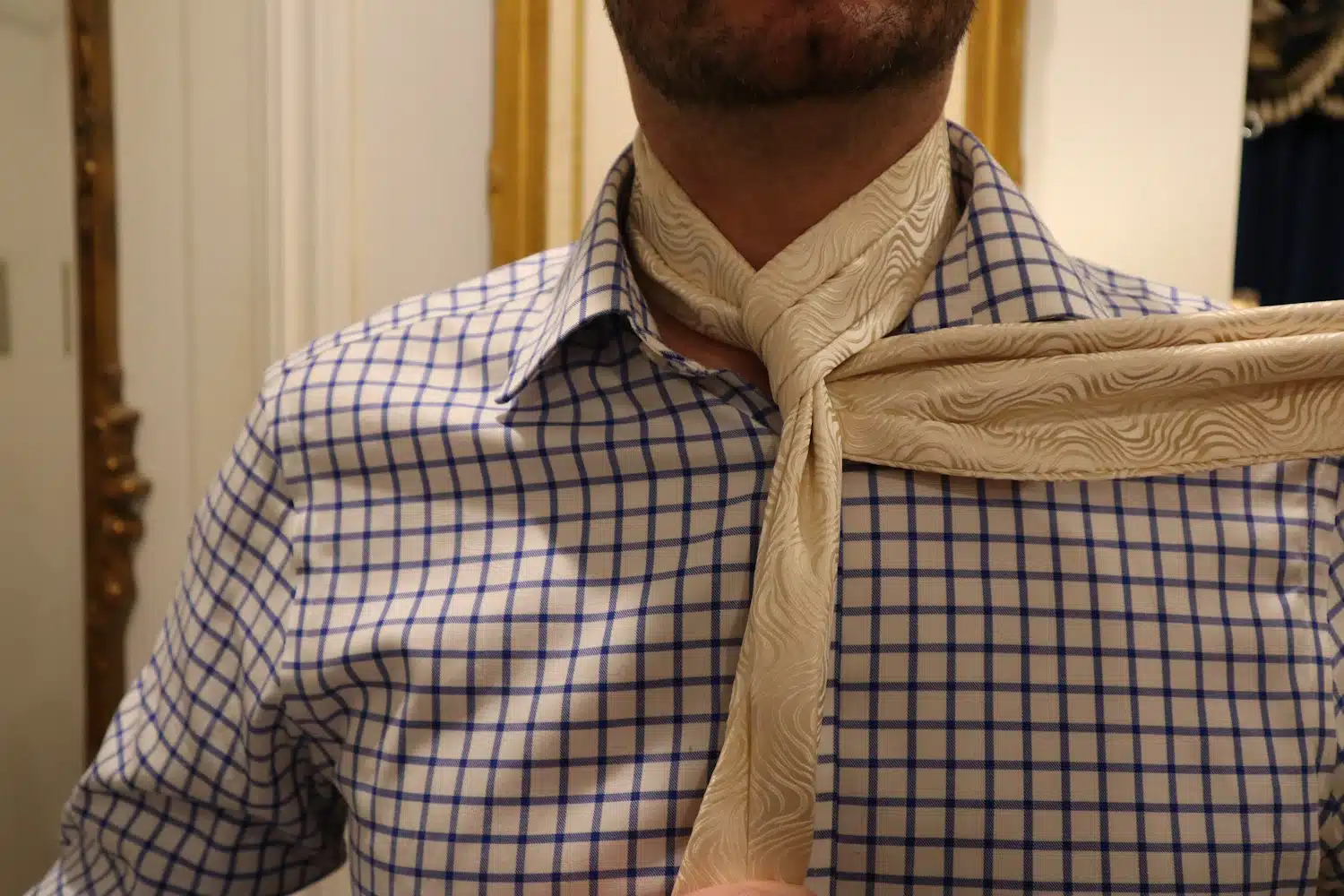
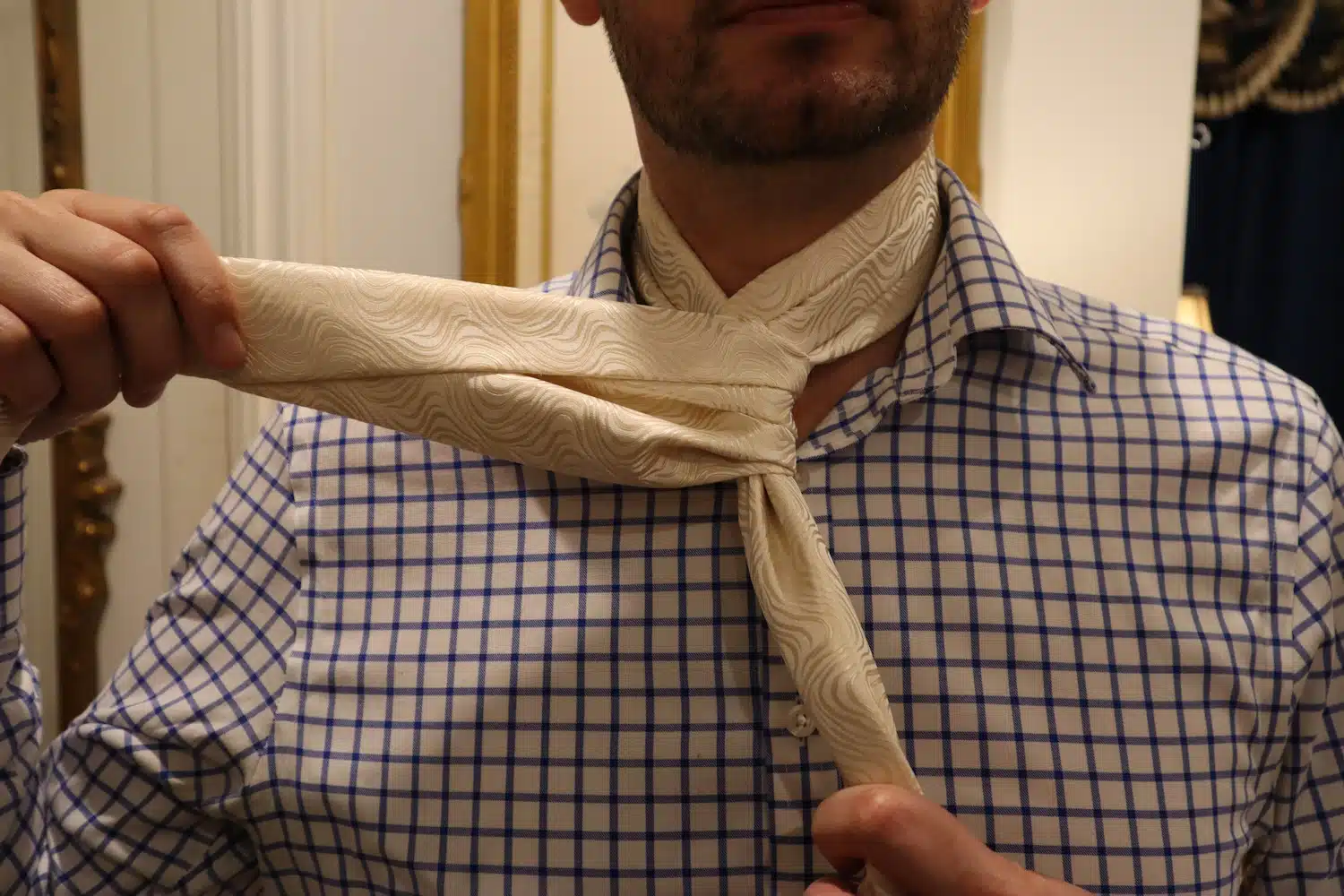
Now that the longer end is wrapped around the shorter end and sitting on top, bring it under and up the crossed pieces. Then, you’ll take that piece and hang it over both sides. You’re basically just doing an under-up-and-over motion.
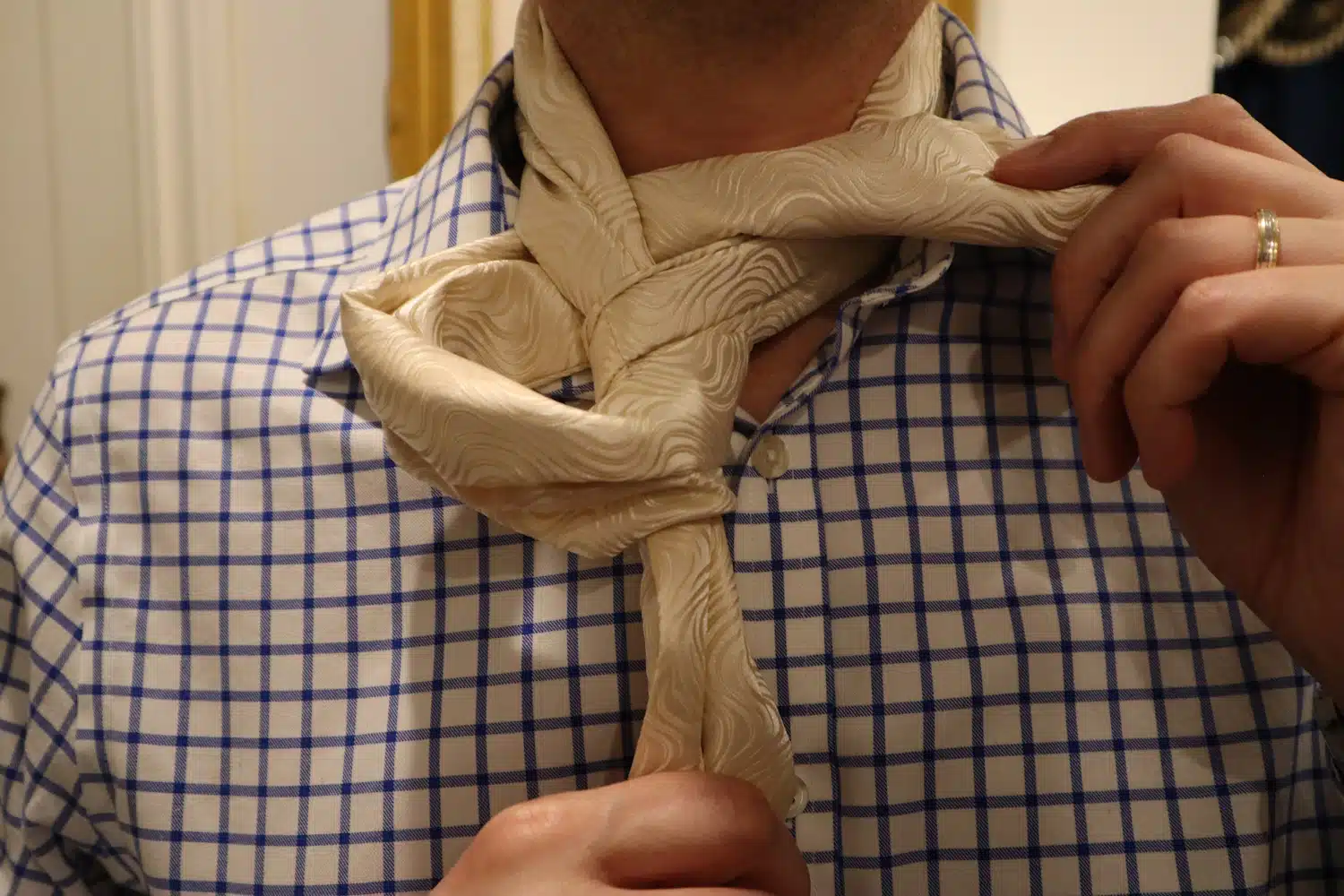
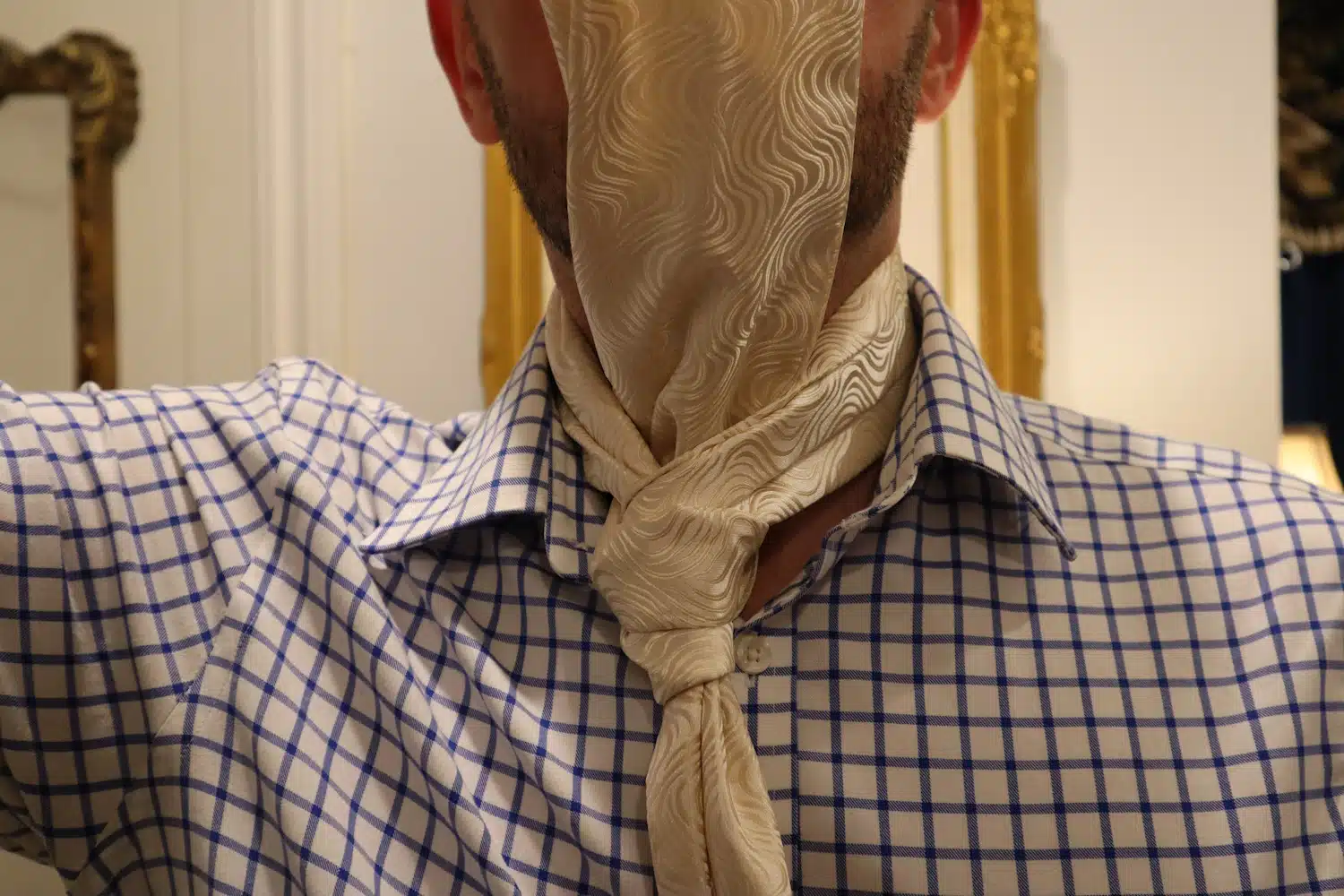
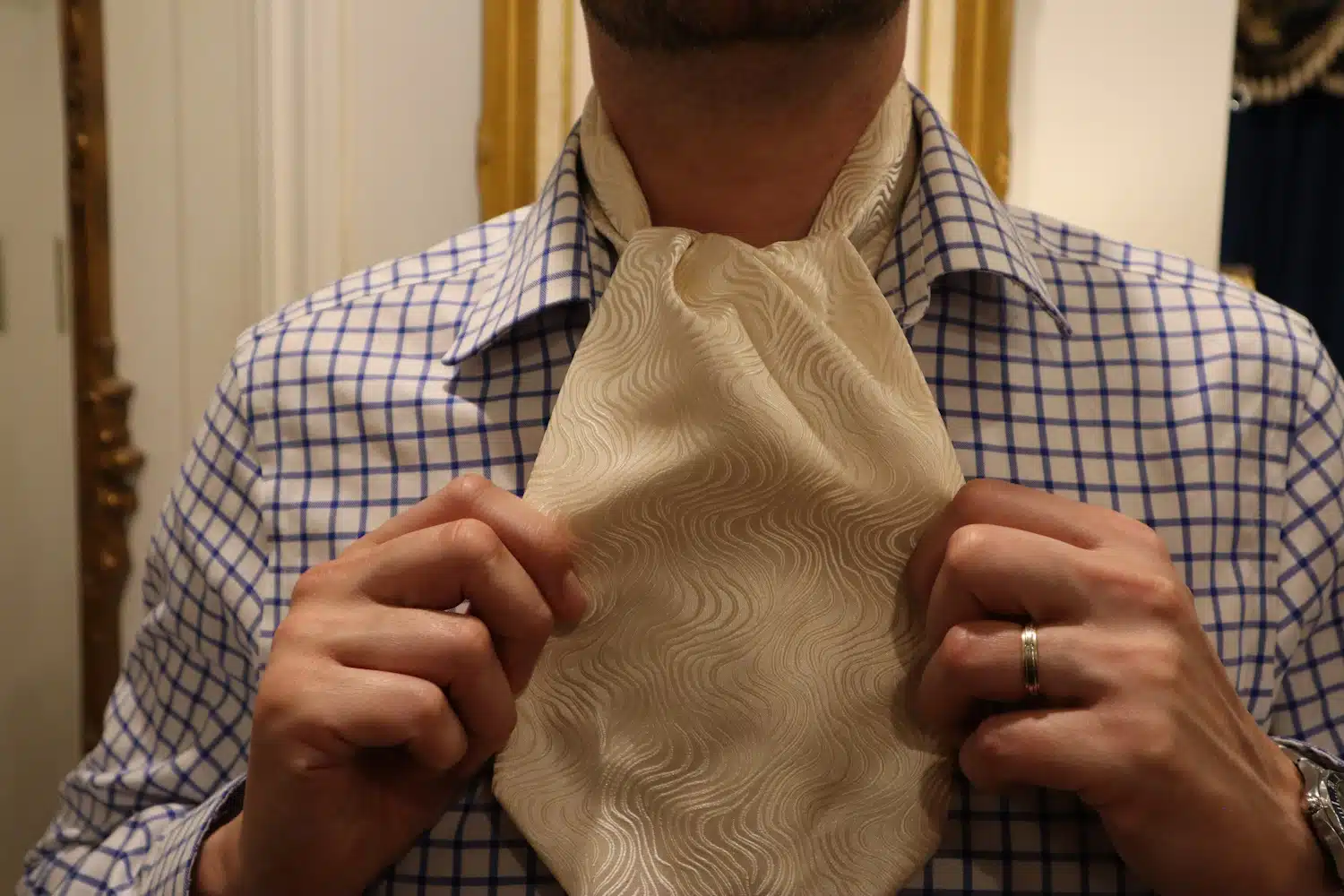
Now that the (formerly) longer piece is up top, you’ll adjust it to make it wider, completely covering the piece underneath it, and stick it in your shirt — voila!
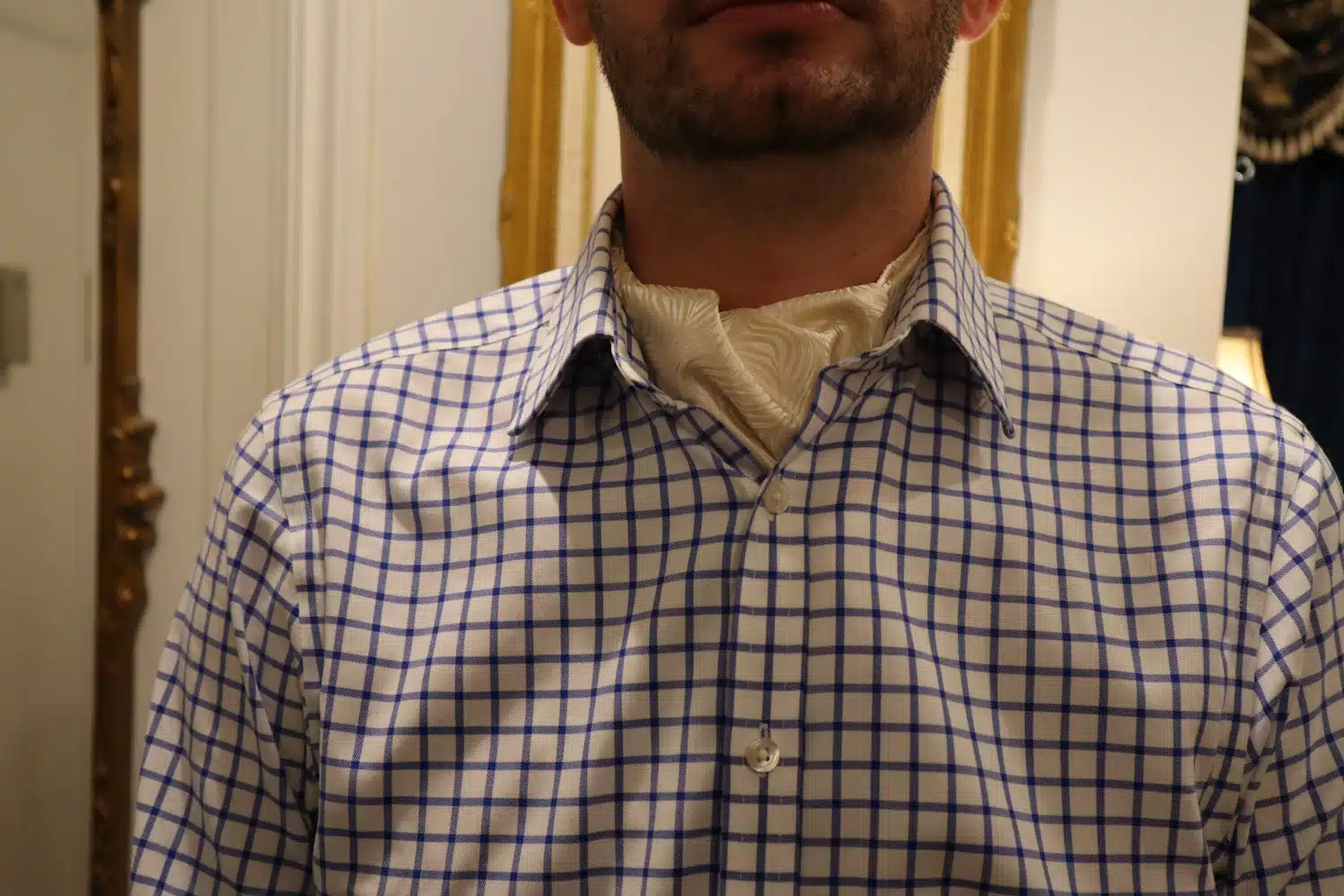
Lets now move on to the Four In-Hand ascot tie.
The Four In-Hand Tie
The first four steps are exactly the same as the first four above. So refer to all of that.
Once wrapped the longer end around the shorter end and brought up and over, you’ll follow these extra steps instead of just adjusting the look.
You’ll take the (formerly) longer end and put it through the knot. It’s a lot like a necktie.
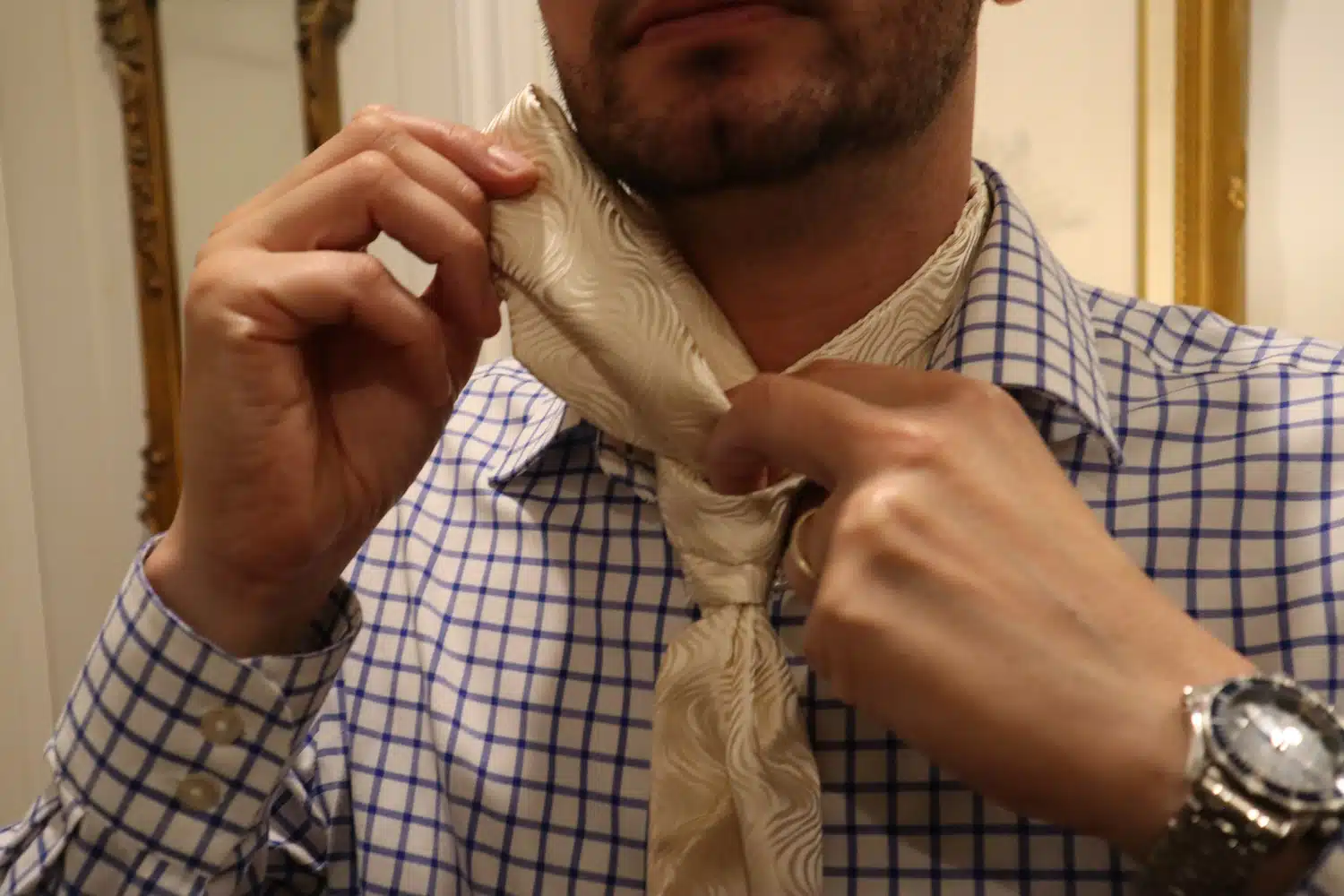
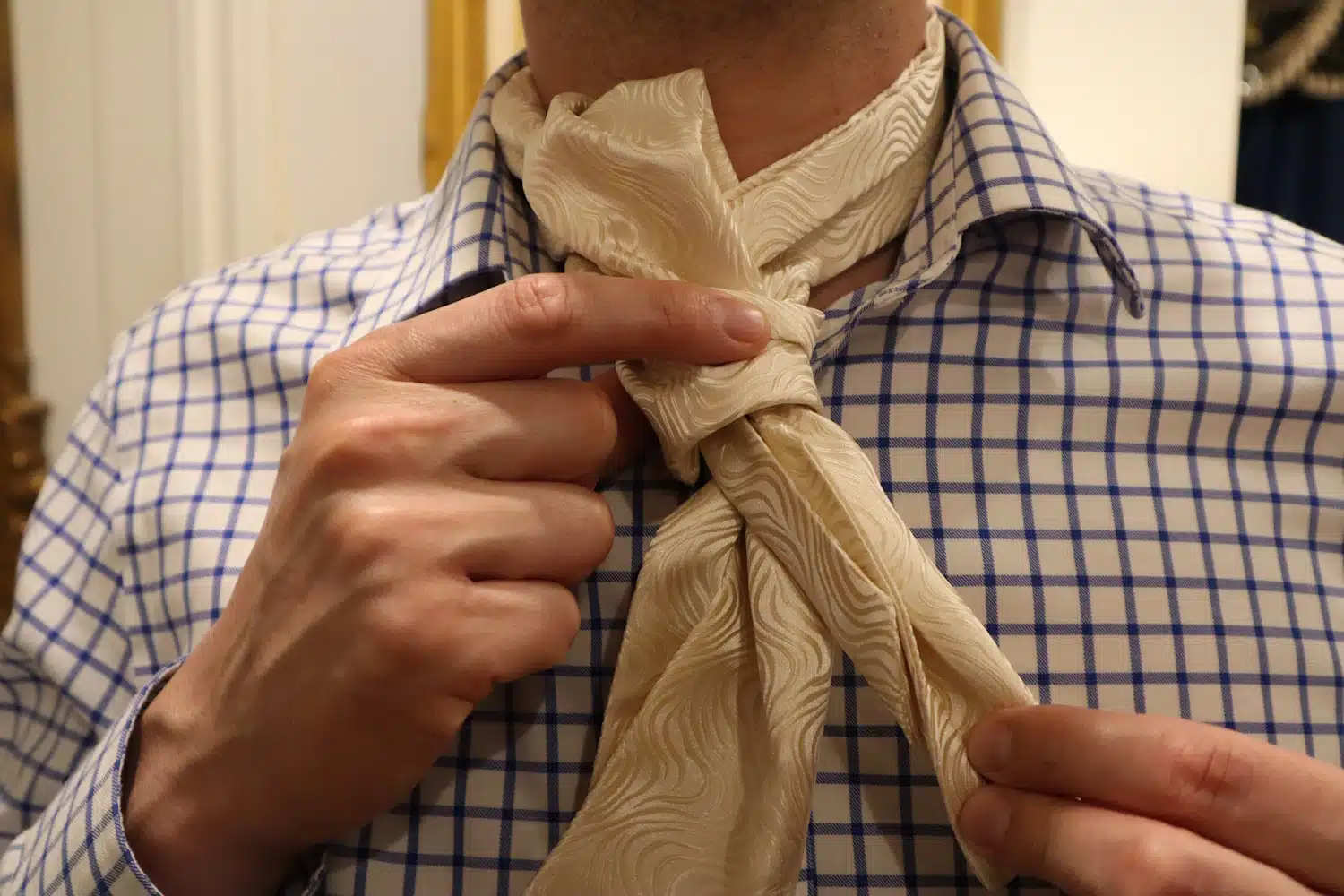
Tighten that knot a bit. Don’t tighten it like you would a necktie, though. This isn’t the last step. And unlike a tie, the front end will, and should, be longer than the back piece.
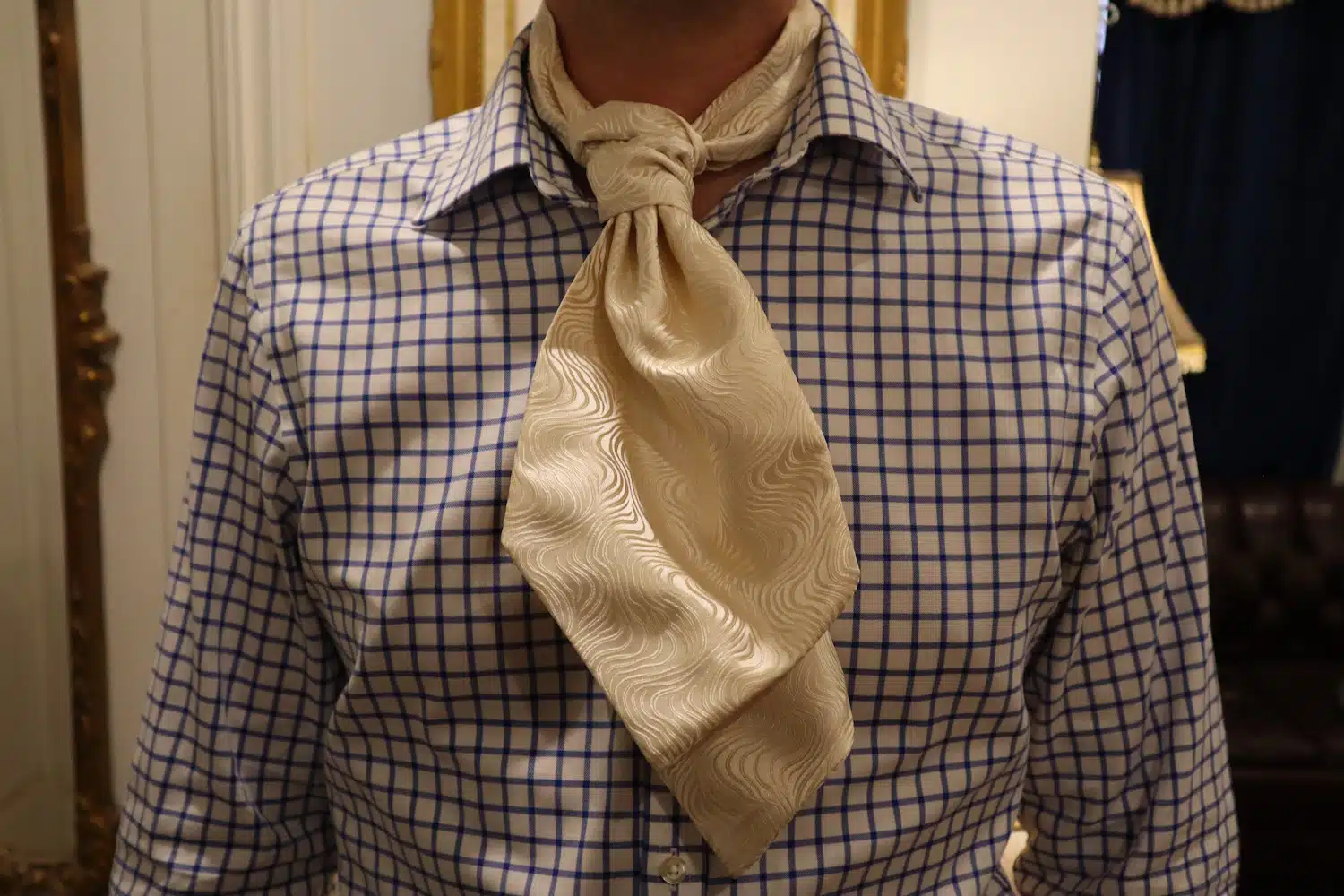
Now, take the back end, which is no longer, and bring it up, behind the knot area, and over. Then, let it hang over the knot, completely covering the knot.
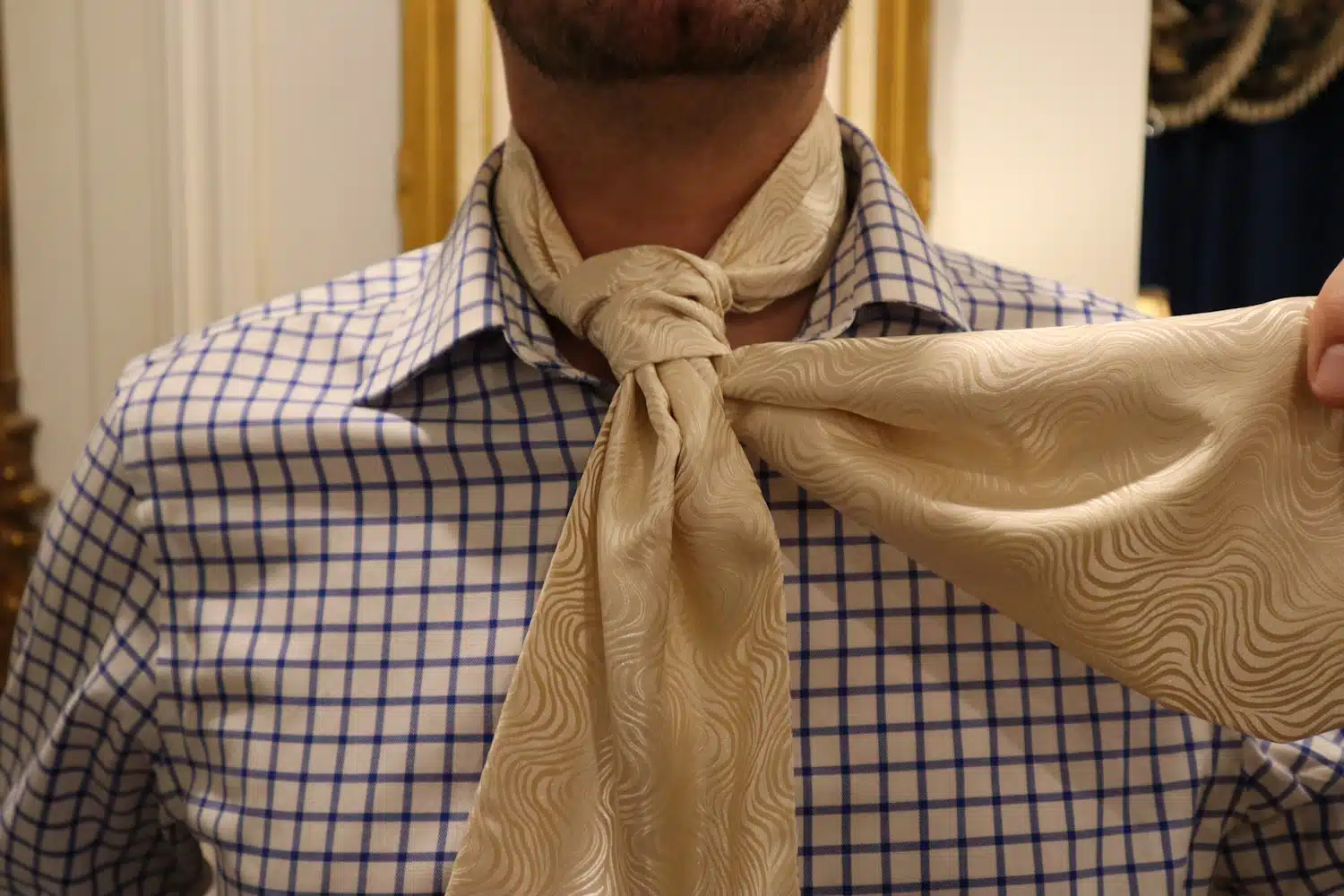
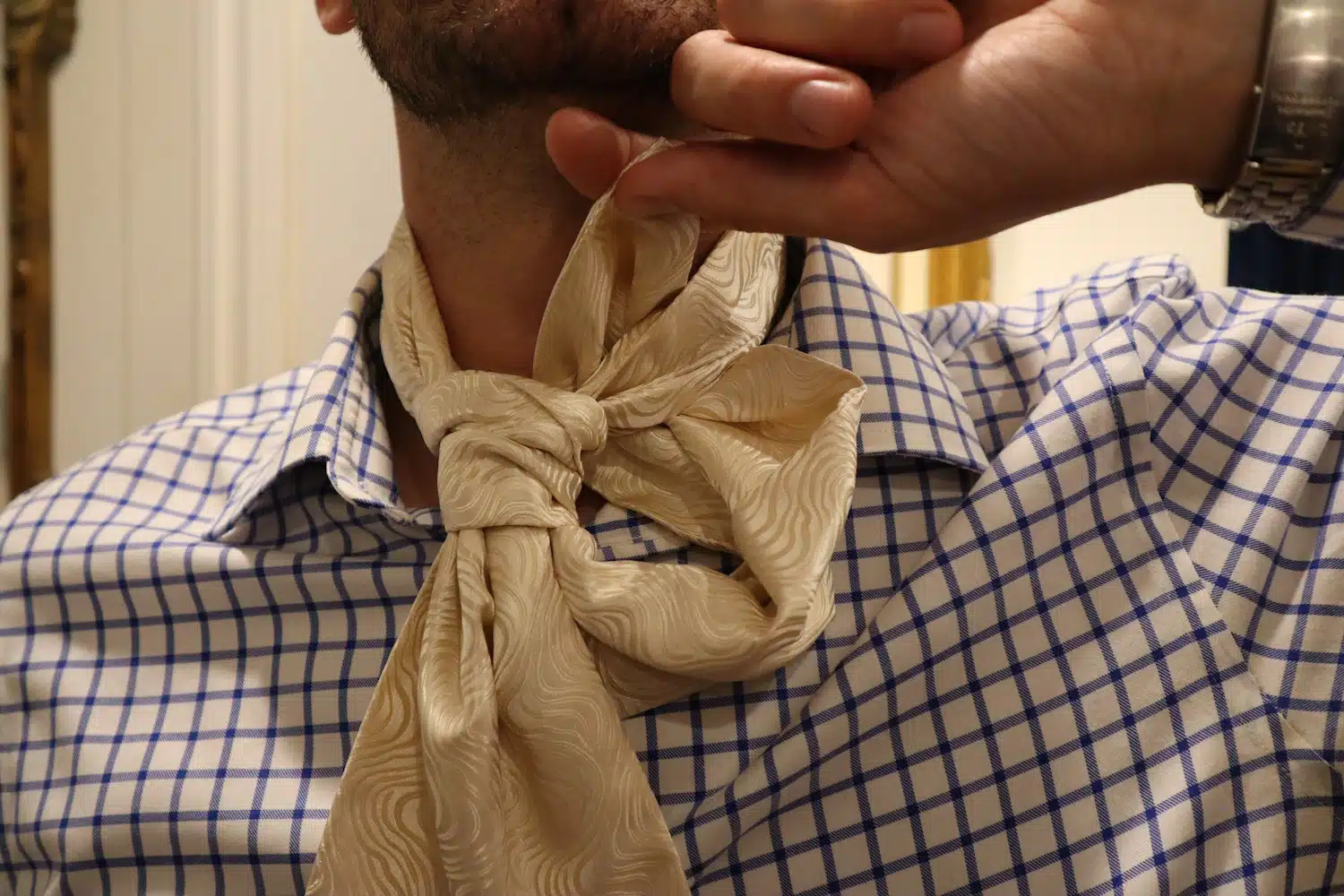
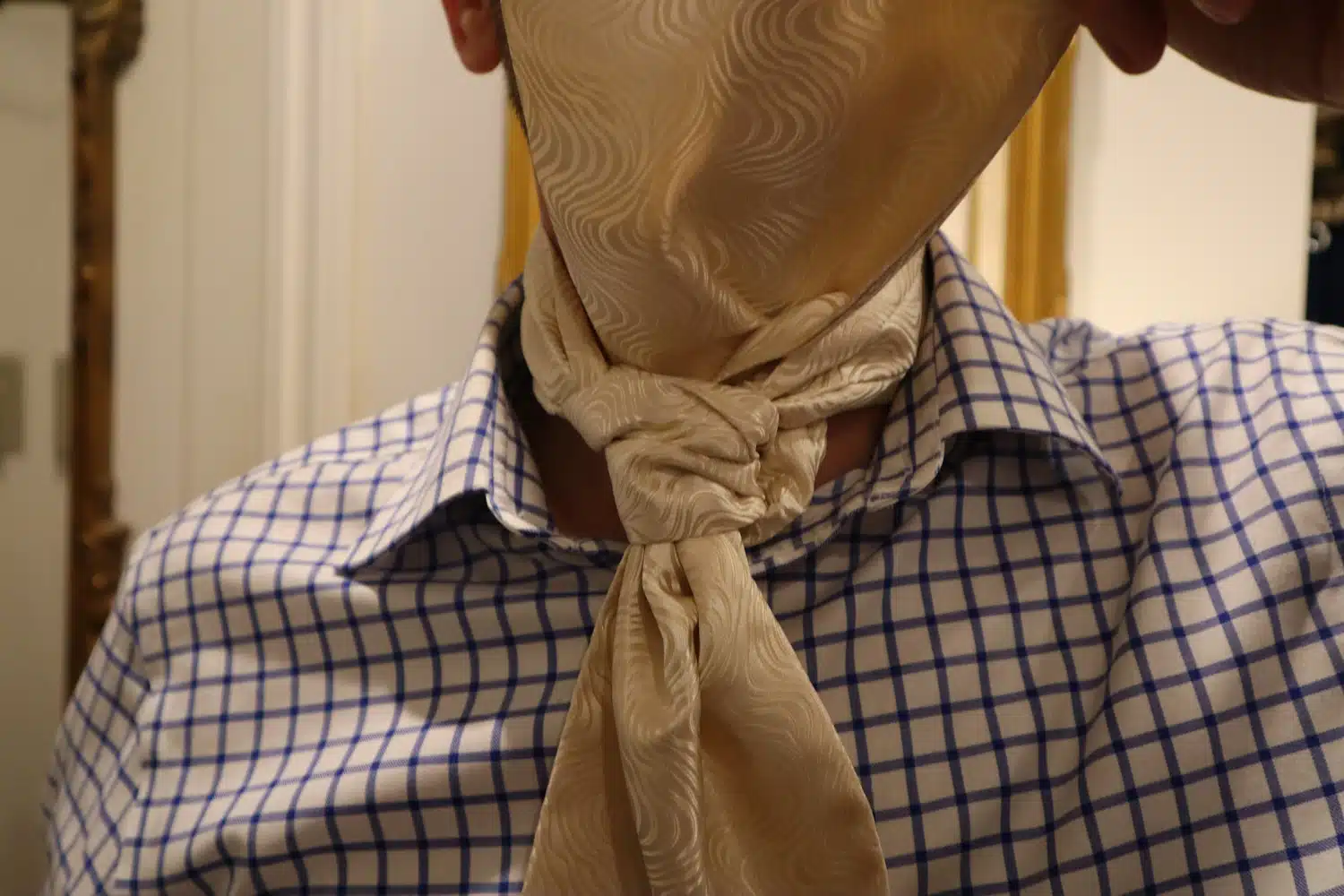
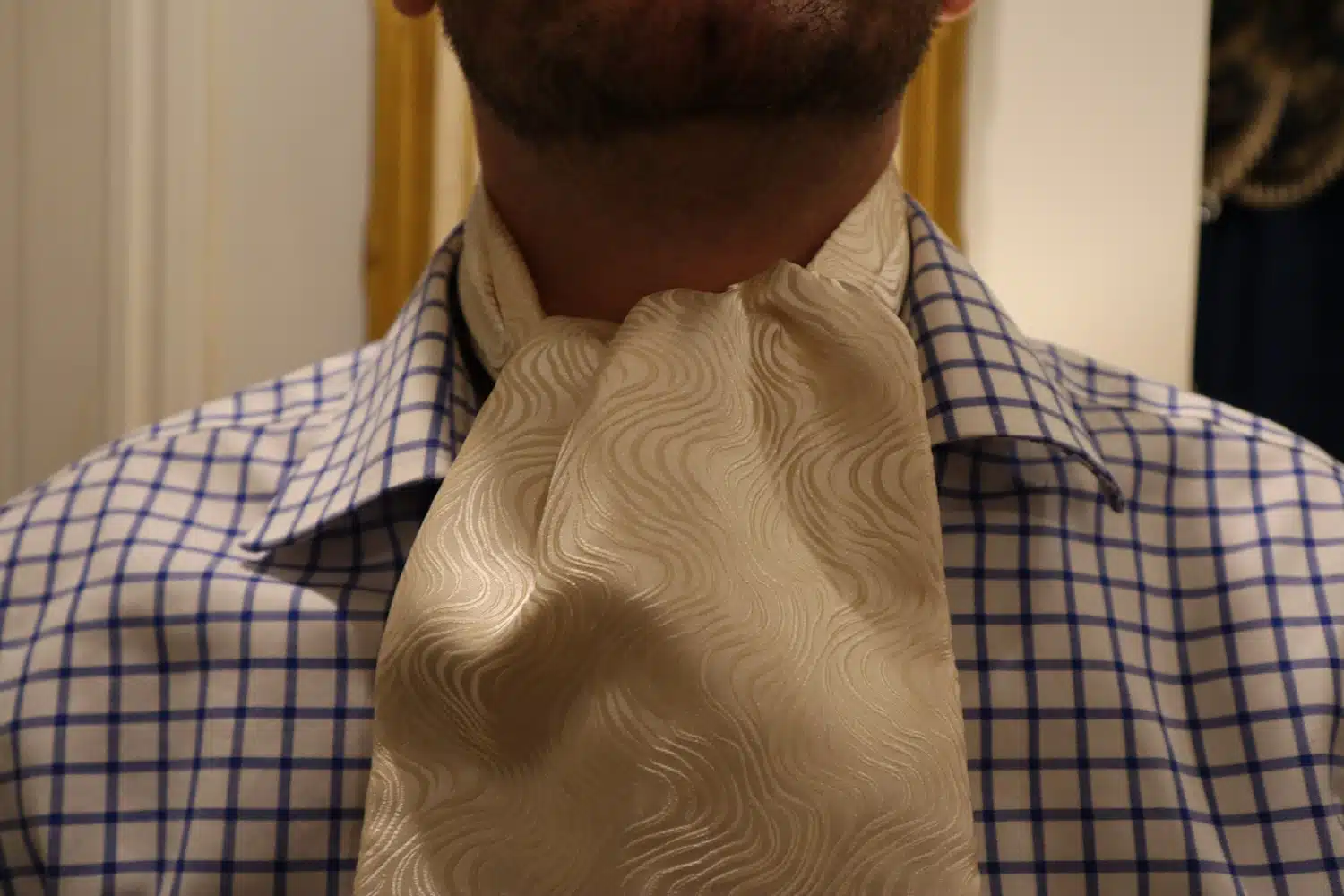
Adjust that front piece and tuck it all in your shirt.
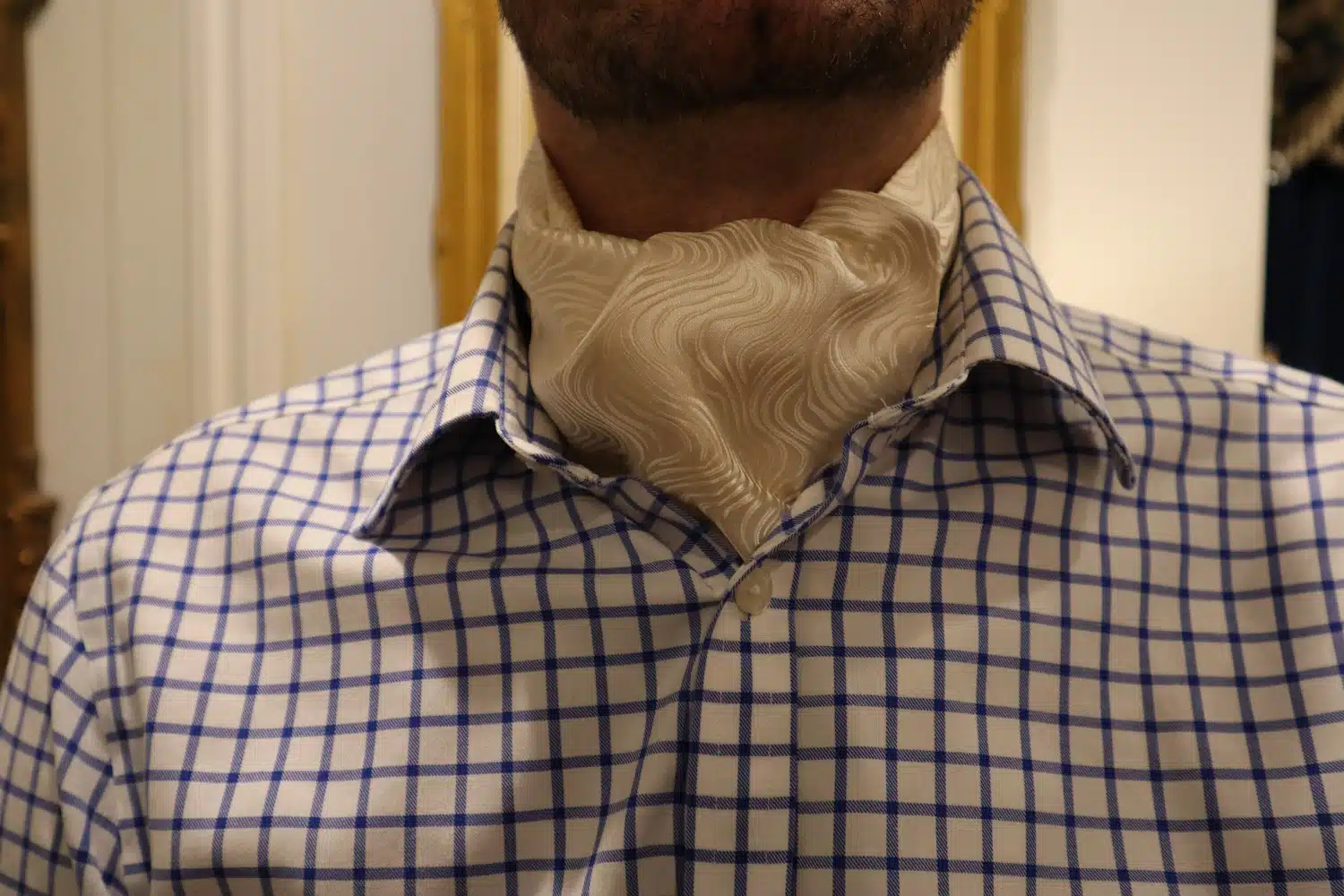
There are two benefits to the four-in-hand knot over the traditional one. First, since you have a necktie-style knot underneath the front piece, you can move the front of the ascot to the side of your neck, and it’ll stay there. Don’t, though.
Second, this is subjective, but it’s a more voluminous look because the front piece is literally stuffed with that knot.
How To Wear an Ascot
Always undo your shirt’s top button. Otherwise, you’re mostly covering up the ascot.
You can also unbutton the second button for a more casual look. This has a more gentlemen-on-safari vibe. The one-button approach is likely what you might wear to a day wedding in the English countryside.
How high or low you wear your ascot is totally subjective. You can wear it so low that the neckband is mostly hidden, and it just looks like you have a decorative poof behind your front collar.
Or, you can wear it a touch higher so that the cravat is essentially accenting your entire shirt collar, all the way around.
Traditionally, a more formal cravat approach includes wearing a thick, dark-colored ascot with striped or gray formal trousers, a vest, and a cutaway coat.
You can even decorate the front of your ascot with a tie pin. This is common in formal English weddings and is a sort of equivalent to a black tuxedo with a bow tie.
A more casual approach would be wearing your ascot as one would wear a day cravat. Choose a thinner, comfortable silk ascot, and wear it with any smart casual outfit. You can go for a broken suit, replacing the matching trousers with khakis. Or, wear your ascot with a tweed blazer.
Have fun with colors and patterns, and pair it with your outfit the same way you would when choosing a tie color. If your tweed jacket has subtle blue accents, go for a blue ascot. If you’re wearing maroon dress socks and loafers, go for a maroon or maroon-accented ascot.
And as always, think about balance when putting an outfit together. If you’re wearing a patterned shirt or jacket, temper the combination with a solid ascot. If your outfit has a lot of bold and solid color blocks, go for a complementary pattern with accents that are tonal to some of your pieces of clothing.
Who Should Wear an Ascot
Admittedly, an ascot has a dandy aesthetic to it. However, regardless of personal style, anyone can wear an ascot in certain situations.
If you go to a formal day wedding or find yourself at a dressed-up event at an actual horse track, you can go for an ascot! It wouldn’t look out of place even if it isn’t required.
If you want a man-of-leisure or academia vibe with your smart casual outfits, an autumn-toned ascot will look dapper yet relaxed with a jacket, khakis, and a button-down shirt.
Of course, if you do love a dandier personal style and haven’t tried incorporating an ascot into your rotation, you definitely should. It could complement your dapper-forward look even better than a necktie would.
Be Bold Try Wearing an Ascot
When it comes to style, incorporating ascots into your rotation is a good way to add some diversity and flare.
On the practical front, knowing how to tie one is like having tire-changing gear in your trunk and tire-changing know-how in your head. Perhaps most of us will almost never need to wear an ascot. But you never know — you might get a Royal Ascot invite one day.
Would you ever wear an ascot? Why or why not? Let me know in the comments!








Ask Me Anything